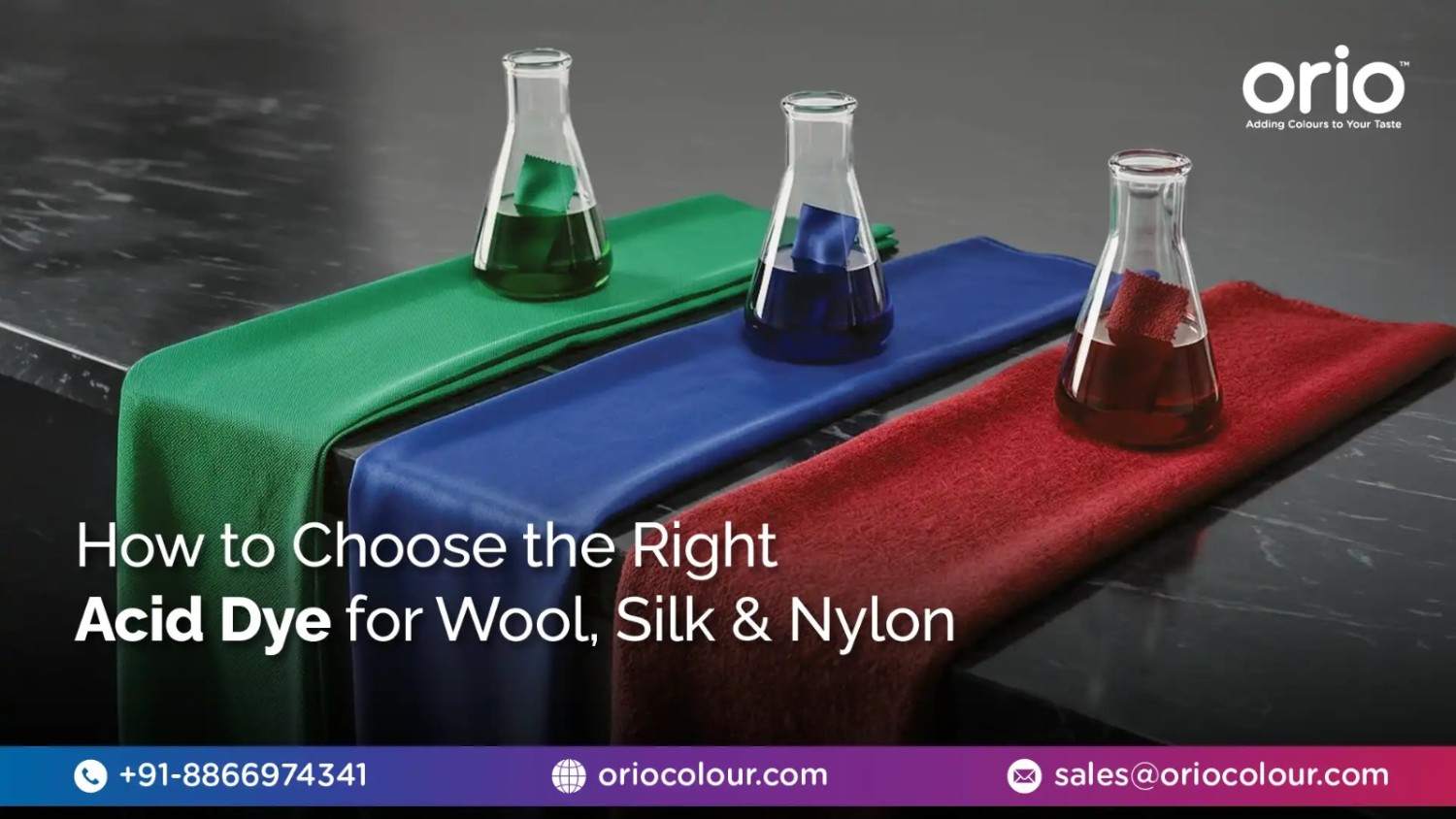
Selecting a dye for wool, silk or nylon involves more than matching a shade card. Fibre chemistry, dyeing pH, temperature, levelness and fastness requirements all influence the final result. A dye that performs well on wool may require different processing conditions on silk or nylon.
This acid dye selection guide explains the practical factors manufacturers should evaluate when choosing acid dyes for wool, silk and nylon, with a focus on consistent shade development, process control and end-use performance.
Why Fibre Type Matters in Acid Dye Selection
Acid dyes are water-soluble anionic dyes typically applied from an acidic dye bath. Their affinity for protein fibres and polyamide fibres makes acid dyes for textile processing particularly relevant to wool, silk and nylon. Orio Colours identifies wool, silk and nylon among the key fibres for its acid dye portfolio.
However, these fibres do not respond identically during dyeing. The dye must therefore be selected around the substrate rather than shade alone.
Acid Dyes for Wool:
Wool has strong affinity for acid dyes and can produce shades ranging from bright colours to deep tones. The main challenge is controlling dye uptake so that colour develops evenly without compromising fibre quality.
When evaluating acid dyes for wool, consider:
- Required levelness and migration
- Wet and washing fastness
- Dyeing temperature and pH
- Shade depth
- End use of the wool product
Leveling acid dyes can be suitable where uniformity and migration are priorities, while milling and super-milling types may be considered when stronger wet-fastness performance is required.
Acid Dyes for Silk:
Silk requires careful processing because maintaining its appearance, handle and lustre is important. Dye selection should therefore combine shade brilliance with controlled affinity.
For acid dyes for silk, manufacturers should assess whether the dye provides good solubility, controlled uptake and uniform colour development under the intended process conditions. Orio describes its acid dyes as engineered for solubility, even dyeing and consistency, characteristics that are especially relevant when processing delicate fibres.
Trial dyeing is valuable when developing a new shade because small changes in pH, temperature or concentration can influence the finished colour.
Acid Dyes for Nylon:
Nylon is a synthetic polyamide fibre, but its chemical structure gives it affinity for acid dyes. Uniformity can become challenging where there are variations in fibre structure or dye uptake.
When selecting acid dyes for nylon, processors should evaluate:
- Affinity and build-up behaviour
- Level-dyeing characteristics
- Desired colour depth
- Fastness requirements
- Compatibility with the actual nylon substrate
Testing the dye on the production-grade material is preferable to approving a colour purely from a standard shade reference.
Acid Dye Selection Guide: 5 Factors to Evaluate
1. Start With the Required Shade
Define the target colour and acceptable shade tolerance first. Bright yellows and reds may have different performance requirements from deep browns, greens or blacks. Orio’s current acid dye portfolio includes shades across these colour families.
2. Match Dye Class to Performance
Different acid dye classes provide different balances of migration, levelness and fastness. Leveling dyes prioritise uniform dyeing, while milling, super-milling and metal-complex dyes can offer different durability and fastness characteristics.
The best choice depends on the finished textile rather than simply selecting the strongest dye.
3. Evaluate Fastness Requirements
Consider how the dyed material will be used. Apparel, furnishing textiles and other applications can face different exposure to washing, rubbing, perspiration and light. Specify the required fastness criteria before finalising the dye.
4. Check Process Compatibility
Acid dye performance depends on controlled processing. Review the intended pH, temperature, dye concentration and auxiliary system. Orio notes that fibre type, processing conditions and required durability are key considerations when selecting an acid dye.
5. Validate Before Bulk Production
Laboratory trials should assess shade accuracy, levelness, dye uptake and relevant fastness properties. This helps manufacturers establish repeatable processing parameters before scaling up.
Why Consider Orio Colours for Acid Dye Requirements?
Orio Speciality Colours offers acid dyes for wool, silk, nylon and other applications, with its product range including CI Acid Yellow 23, Acid Red 1, Acid Red 18, Acid Green 104 and several brown and black grades. The company highlights high dye uptake, shade uniformity, water solubility and consistent dyeing performance across its acid dye solutions.
Its broader manufacturing approach also includes in-house R&D and quality control, customer-specific testing and customised colour solutions.
Conclusion
Choosing acid dyes for wool, silk and nylon requires a fibre-specific approach. Shade is important, but levelness, affinity, fastness and compatibility with actual dyeing conditions ultimately determine whether a colour performs reliably in production.
For textile manufacturers, establishing these requirements before dye selection can reduce shade variation, improve process consistency and support dependable finished-product quality.
Find the Right Acid Dye with Orio Colours
Need an acid dye suited to your fibre, shade and processing requirements? Orio Colours can support manufacturers in identifying appropriate acid dye solutions for wool, silk and nylon applications. Explore Orio Colours’ Acid Dyes or connect with its technical team to discuss your application and required shade.
FAQs
1. What are acid dyes used for?
Acid dyes are commonly used for dyeing protein fibres such as wool and silk, as well as polyamide fibres like nylon.
2. How do you select acid dyes for wool?
Consider shade, levelness, dyeing pH, temperature, fastness requirements and the intended end use of the wool product.
3. Are acid dyes suitable for silk?
Yes, acid dyes can be used for silk to achieve bright and uniform shades when suitable dyeing conditions are maintained.
4. Can acid dyes be used for nylon?
Yes, acid dyes have good affinity for nylon and can be selected based on shade depth, levelness, compatibility and required fastness.
5. What factors affect acid dyeing?
Fibre type, pH, temperature, dye concentration, dye compatibility and processing conditions can affect the final shade and dyeing performance.