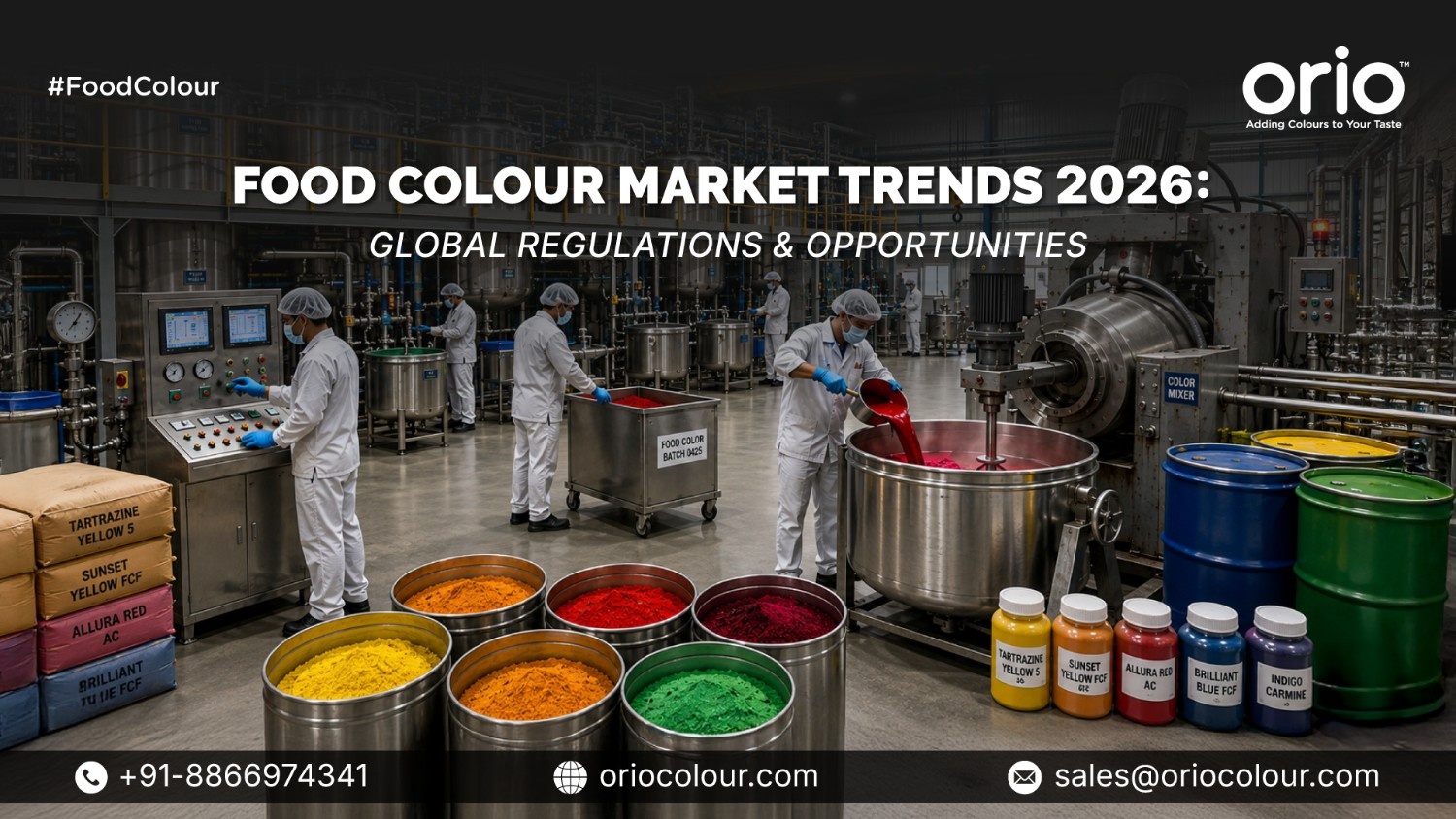
Food colour market trends in 2026 are being shaped by stricter global regulations, rising demand for natural and clean-label ingredients, evolving consumer preferences, and innovation in food colouring technologies. These changes are creating new opportunities for manufacturers to develop compliant, stable, and sustainable food colour solutions for global markets.
The global food and beverage sector is undergoing a major transformation driven by evolving consumer preferences, stricter compliance frameworks, and formulation innovation. As brands focus on cleaner labels, visual consistency, and export-ready products, the food colour market 2026 is expected to become more regulation-driven and application-focused than ever before.
For manufacturers, this shift is no longer limited to selecting attractive shades. Colour systems must now align with stability requirements, international approvals, ingredient transparency, and region-specific consumer expectations.
This changing landscape is reshaping the global food colour market across beverages, confectionery, bakery, dairy, snacks, nutraceuticals, and functional foods.
Understanding Food Colour Market Trends in 2026
Several factors are influencing emerging food colour market trends globally.
Clean-Label Product Development:
Manufacturers are increasingly reformulating products to meet consumer demand for recognisable ingredients and reduced synthetic dependency. This is accelerating interest in:
- Plant-derived colour systems
- Nature-identical blends
- Custom shade solutions with label-friendly positioning
Demand for Visual Consistency:
Consumers associate colour consistency with product quality. As brands expand globally, maintaining identical shades across production locations has become a formulation priority.
This is particularly important for:
- Beverage manufacturers
- Confectionery brands
- Packaged snack producers
- Functional food companies
Growth in Processed and Convenience Foods:
The continued expansion of ready-to-eat and packaged food categories is contributing to rising food colour demand. Manufacturers require colour systems capable of maintaining performance under:
- Heat processing
- pH variation
- Light exposure
- Extended shelf-life conditions
What is driving food colour market growth in 2026?
Food colour market growth in 2026 is driven by clean-label demand, stricter synthetic additive regulations, technological innovation in natural pigments, and increased global demand for visually appealing food products.
Global Food Colour Market Outlook
The global food colour market is expected to witness sustained expansion as manufacturers invest in product differentiation and regulatory-ready formulations.
Key growth regions include:
- UAE
- Vietnam
- China
Emerging product segments driving food colour market growth include:
- Functional beverages
- Premium confectionery
- Plant-based foods
- Clean-label bakery products
- Nutraceuticals and fortified foods
As export-focused production increases, manufacturers are prioritising colour systems that meet multiple regulatory standards simultaneously.
Food Colour Regulations Shaping the Industry
One of the most significant factors influencing the industry in 2026 will be evolving food colour regulations.
Regulatory authorities are increasing scrutiny around:
- Ingredient traceability
- Permitted additive limits
- Labelling accuracy
- Product safety documentation
Major compliance frameworks influencing global trade include:
- FDA requirements in the United States
- FSSAI regulations in India
- EFSA guidelines across Europe
- ISO 22000 food safety systems
- Halal and Kosher certifications for broader market acceptance
- GMP-compliant manufacturing practices
For exporters, regulatory alignment is becoming a competitive advantage rather than a procedural requirement.
Manufacturers unable to meet evolving compliance standards may face:
- product approval delays
- restricted market access
- reformulation costs
- supply chain disruptions
This makes regulatory preparedness a critical part of modern colour selection strategy.
Food Colour Industry Analysis: What Manufacturers Are Prioritising
Current food colour industry analysis shows that buyers are increasingly evaluating suppliers based on technical capability rather than only pricing.
Manufacturers now prioritise:
- Shade consistency across batches
- Stability during processing
- Application-specific recommendations
- Documentation support
- Faster customisation capability
- Multi-region regulatory compliance
There is also growing preference for suppliers capable of supporting:
- custom blends
- low-dosage efficiency
- clean-label adaptation
- colour matching for premium products
This shift is creating stronger demand for technically driven colour solution providers.
Food Colour Industry Opportunities in 2026
The evolving market is opening significant food colour industry opportunities across multiple segments.
- Customised Colour Solutions: Brands increasingly require unique shades aligned with product identity and regional preferences.
- Clean-Label Innovation: Manufacturers investing in stable natural and blended systems are expected to gain long-term market relevance.
- Export-Focused Manufacturing: Global food brands require colour partners capable of supporting cross-border compliance and documentation requirements.
- Functional Food Expansion: Nutraceuticals, fortified foods, and wellness beverages are creating demand for colour systems compatible with sensitive formulations.
- Premium Product Positioning: Colour consistency is becoming essential in premium product categories where visual presentation directly influences purchasing decisions.
How Orio Colours Supports Emerging Market Needs
As the market evolves, companies require partners capable of balancing compliance, innovation, and application performance.
Orio Colours focuses on delivering:
- Custom shade development
- Application-specific colour solutions
- Compliance-driven manufacturing support
- Consistent batch performance
- Multi-industry expertise across food, beverages, pharma, and cosmetics
By aligning technical formulation support with changing market expectations, Orio helps manufacturers respond more effectively to evolving industry demands.
Conclusion
The food colour market 2026 will be shaped by regulation, formulation precision, and consumer-driven innovation. As the industry moves towards cleaner labels, global compliance, and customised product experiences, colour systems will play a more strategic role in manufacturing and brand differentiation.
Businesses that invest in compliant, stable, and application-ready colour solutions will be better positioned to capture future growth opportunities in the expanding global marketplace.
Partner with Orio Colours - Excellence in Every Shade
Looking for advanced colour solutions aligned with evolving global standards and market expectations?
Orio Colours delivers customised, compliance-focused colour systems designed for modern food and beverage applications.
Connect with Orio to develop high-performance colour solutions tailored to your industry needs.