
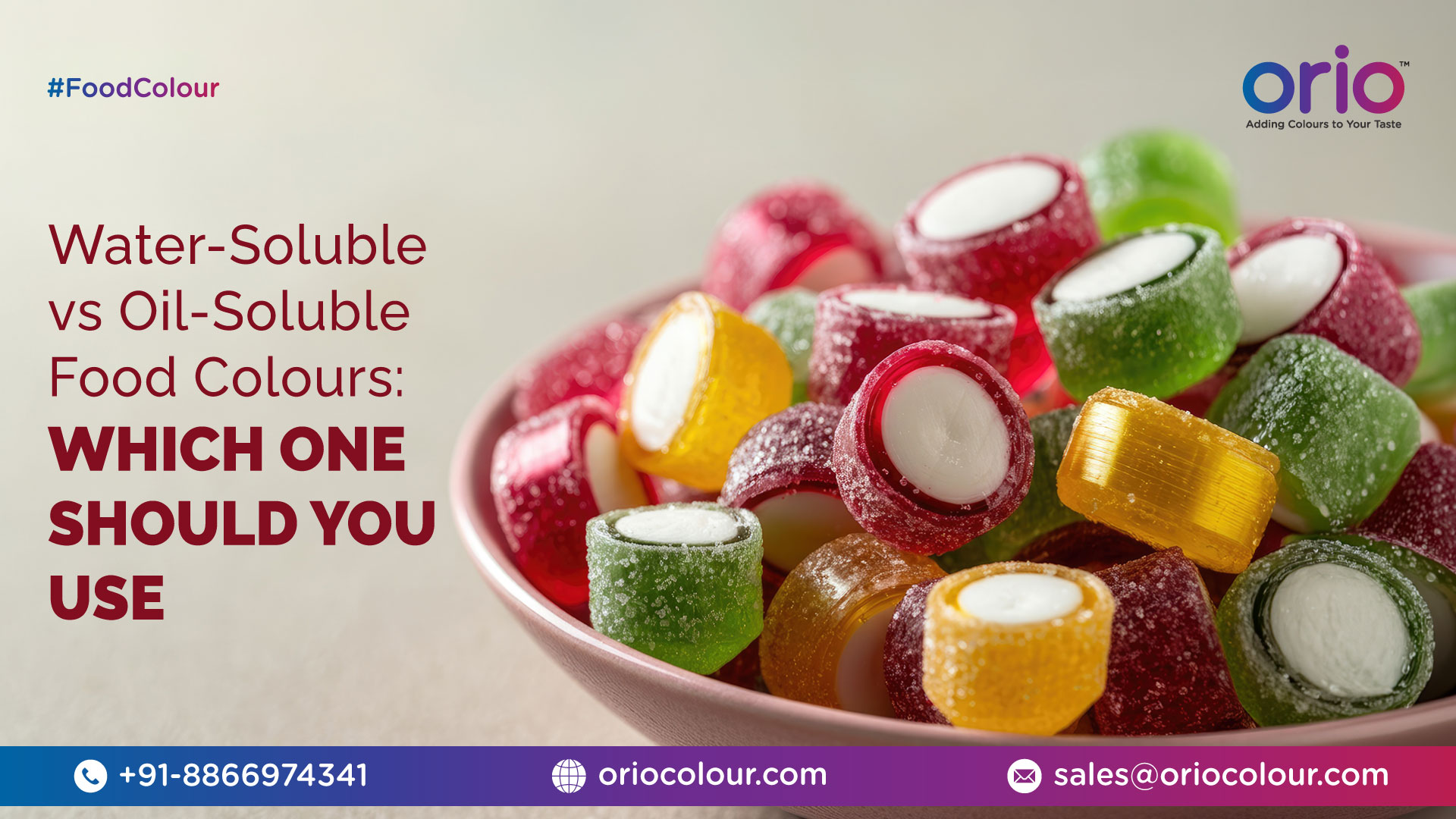
Selecting the right colour system is not only about achieving the desired shade. In food manufacturing, colour performance depends heavily on formulation compatibility. A vibrant colour that works perfectly in a beverage may fail completely in chocolate or fat-rich fillings. This is why understanding water soluble vs oil soluble food colours is essential for manufacturers working across different product categories.
Choosing the wrong solubility type can lead to:
- Uneven colour distribution
- Product instability
- Colour bleeding or separation
- Reduced shelf-life consistency
- Reformulation costs during scale-up
For product developers, colour selection must align with the product matrix, processing conditions, and end-use performance requirements.
Understanding Water Soluble Food Colours
Water soluble food colours are designed to dissolve completely in water-based systems. These colours distribute evenly throughout aqueous formulations and are commonly used where clarity and uniformity are important.
Common Applications:
- Soft drinks and flavoured beverages
- Syrups and liquid concentrates
- Dairy drinks
- Jellies and desserts
- Water-based confectionery products
Key Characteristics:
- Rapid dispersion in liquid systems
- Bright and consistent appearance
- Suitable for transparent or translucent products
- Easy process integration during mixing
Because they integrate directly into water-based formulations, they are widely used in high-volume beverage and processed food manufacturing.
Understanding Oil Soluble Food Colours
Unlike water-dispersible systems, oil soluble food colours are formulated for fat-based applications where water-soluble colours cannot perform effectively.
These colours dissolve in oils, fats, and lipid-rich systems, ensuring stable colour distribution without separation.
Common Applications:
- Chocolate and compound coatings
- Bakery creams and fillings
- Butter and margarine products
- Snack seasonings with oil coatings
- Fat-based confectionery formulations
Key Characteristics:
- Strong compatibility with oil and fat systems
- Better stability in lipid-rich formulations
- Reduced colour migration
- Uniform appearance in coated or fatty products
For manufacturers developing rich or oil-based products, selecting the correct soluble system is critical to maintaining product appearance and processing efficiency.
Difference Between Water and Oil Soluble Food Colours
Understanding the difference between water and oil soluble food colours helps manufacturers avoid formulation issues during production.
| Parameter | Water Soluble Food Colours | Oil Soluble Food Colours |
| Solubility Medium | Water-based systems | Oil and fat-based systems |
| Common Uses | Beverages, syrups, jellies | Chocolates, creams, coatings |
| Dispersion | Dissolves in aqueous formulations | Dissolves in lipid-rich formulations |
| Product Appearance | Clear and vibrant in liquids | Uniform in fatty applications |
| Stability Focus | pH and light stability | Fat compatibility and migration control |
This comparison serves as a practical food colour solubility guide for formulation teams evaluating colour compatibility.
Food Colour Applications Based on Product Type
Successful food colour applications depend on selecting systems that match the formulation environment.
Use Water Soluble Colours For:
- Carbonated drinks
- Sports beverages
- Gummies and jellies
- Ice lollies and syrups
- Liquid nutraceuticals
Use Oil Soluble Colours For:
- Chocolate compounds
- Flavoured oils
- Bakery icings with high fat content
- Snack coatings
- Lipid-based confectionery
Manufacturers working across multiple product categories often require customised colour systems tailored to specific processing conditions.
Food Colour for Oil Based Products: Why Selection Matters
Choosing the right food colour for oil-based products is especially important because incompatible colour systems can lead to:
- Colour separation
- Speckling or uneven distribution
- Surface bleeding
- Reduced visual consistency during storage
Oil-based products require colours that remain stable in fatty matrices while maintaining shade intensity throughout shelf life.
This is particularly relevant in:
- Premium confectionery
- Filled bakery products
- Seasoned snack applications
- Coated nutritional products
Key Factors in Food Colour Selection
Effective food colour selection should involve more than shade preference alone.
Certified food colour solutions help manufacturers meet export regulations, maintain product consistency, and build long-term consumer trust.
Manufacturers should evaluate:
- Product composition
- Water-to-fat ratio
- Processing temperature
- pH conditions
- Shelf-life expectations
- Regulatory requirements
- Target market compliance standards
In export-oriented manufacturing, colour systems must also align with:
- FDA requirements
- FSSAI regulations
- ISO 22000 standards
- Halal and Kosher certifications
- GMP-compliant production practices
A technically aligned selection process reduces reformulation risks and improves production consistency.
How Orio Colours Supports Industry-Specific Colour Needs
Modern manufacturing requires colour systems that perform reliably under real production conditions.
Orio Colours supports manufacturers with:
- Custom shade development
- Water and oil-compatible colour solutions
- Application-specific recommendations
- Compliance-focused manufacturing support
- Consistent batch-to-batch performance
By aligning colour systems with formulation and processing needs, Orio helps businesses achieve both visual consistency and operational efficiency.
Conclusion
Understanding water soluble vs oil soluble food colours is essential for achieving formulation stability, product consistency, and manufacturing efficiency. The correct colour system improves not only appearance but also processing reliability and shelf-life performance.
As product categories continue to diversify, manufacturers need technically compatible colour solutions tailored to their specific applications.
Partner with Orio Colours - Excellence in Every Shade
Looking for application-specific colour solutions for beverages, confectionery, bakery, or specialised formulations?
Orio Colours delivers customised colour systems designed to support performance, compliance, and product consistency across industries.
Connect with Orio Colours to develop the right colour solution for your next formulation.
FAQs
What is the main difference between water-soluble and oil-soluble food colours?
Water-soluble food colours dissolve easily in water-based systems such as beverages and syrups, while oil-soluble food colours disperse effectively in fat-based products like chocolates, coatings, and creams.
When should manufacturers use water-soluble food colours?
Water-soluble food colours are ideal for beverages, jellies, syrups, bakery mixes, and pharmaceutical syrups where fast and uniform dissolution is required.
When are oil-soluble food colours the better choice?
Oil-soluble colours work best in chocolates, confectionery coatings, butter-based products, and fat-rich formulations where water-based colours cannot disperse properly.
Why do manufacturers chooseOrio Colours for food colour solutions?
Orio Colours provides water-soluble, oil-dispersible, synthetic, blended, and natural food colours backed by FSSAI, FDA, ISO 22000, Halal, Kosher, and GMP-compliant manufacturing with technical support for application-specific performance.